

People Are Complex - Our Systems Are Not
Differentiating the simple, complicated, and complex systems in organizations

As a new industry analyst at IDC, my boss and mentor Sue Feldman recommended I read Complexity: The Emerging Science at the Edge of Order and Chaos, by Mitchell M. Waldrop. It blew my mind and set me off on a path that would forever change how I think about making decisions, managing people, engaging others, and defining success.
Modeling A Complex System
As I prepared to do an initial forecast of the emerging enterprise social software market, I was at a loss as to how I might do so effectively. At the time, the market was less than $50M and vendors not only did not want to reveal their current revenues, but no one had any idea of how much or how fast the market would grow.
I faced a gnarly challenge and a complex system which could not be understood using a simple or even complicated linear model - especially since social software’s success relied on the network effects created by having more people use it.
Sue pointed me to a systems dynamics modeling course and software, which allowed me to define market dynamics and assumptions to simulate different scenarios, including the feedback loops created by network adoption. I combined three different forecasts for small, medium, and large organizations to create a forecast and projected that the market would reach $638M by 2012.
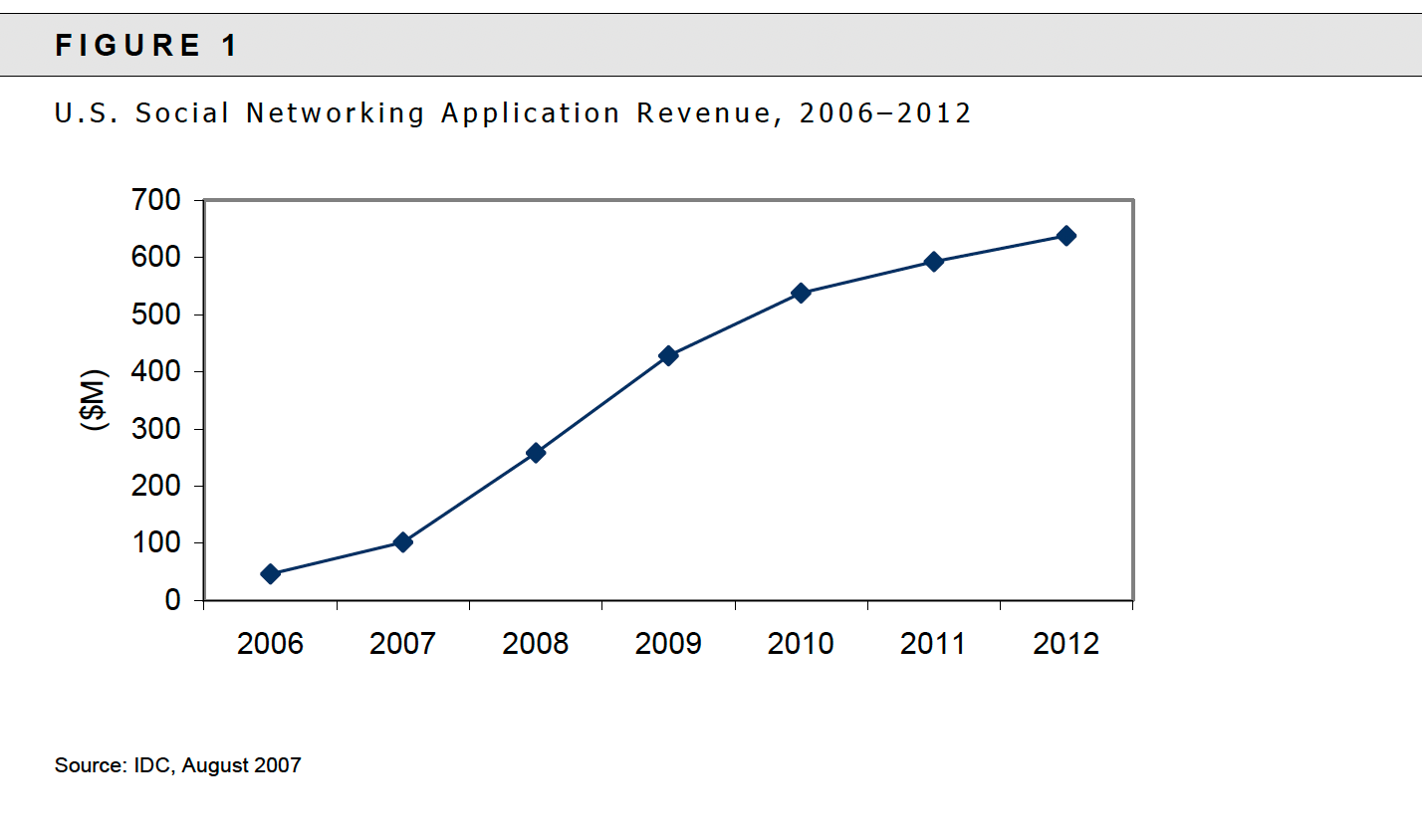
It felt like a fool’s errand, and I was long gone from IDC by the time I needed to answer for it, but the nagging voice in my head got louder as 2012 came and went. My curiosity got the better as did my fear that I was wildly off. IDC’s 2012 figure for the market was $800M - about 20% more than I had projected five years earlier.
While I expected it to be off, I was impressed I had been as close as it was, given the minuscule size of the market in 2006 and the abject lack of defensible inputs. More than that, however, it reinforced my emerging understanding of complex systems and how systems thinking, which was largely used in the context of engineering, could be applied to social systems and economies.
What’s Different About Complex Systems?
I was a business analyst and researcher long before I learned about complexity and many of the approaches I was familiar with were, at their core, based on relatively basic calculations and segmentation. Elements of systems were handled somewhat discretely rather than connected dynamically to the performance of other elements. While we did not abstract or make inferences about what might happen because of those relationships, it left a hole in our understanding.
What I didn’t know was that I was often trying to understand complex systems using an analysis approach better suited to simple and complicated systems. Simple and complicated systems work off a more logical mental model grounded in cause and effect. While complicated systems can be very complicated - think airplanes and nuclear plants - their components are integrated through triggers and sequences. In basic terms, there is a beginning and an endpoint that can be clearly defined.
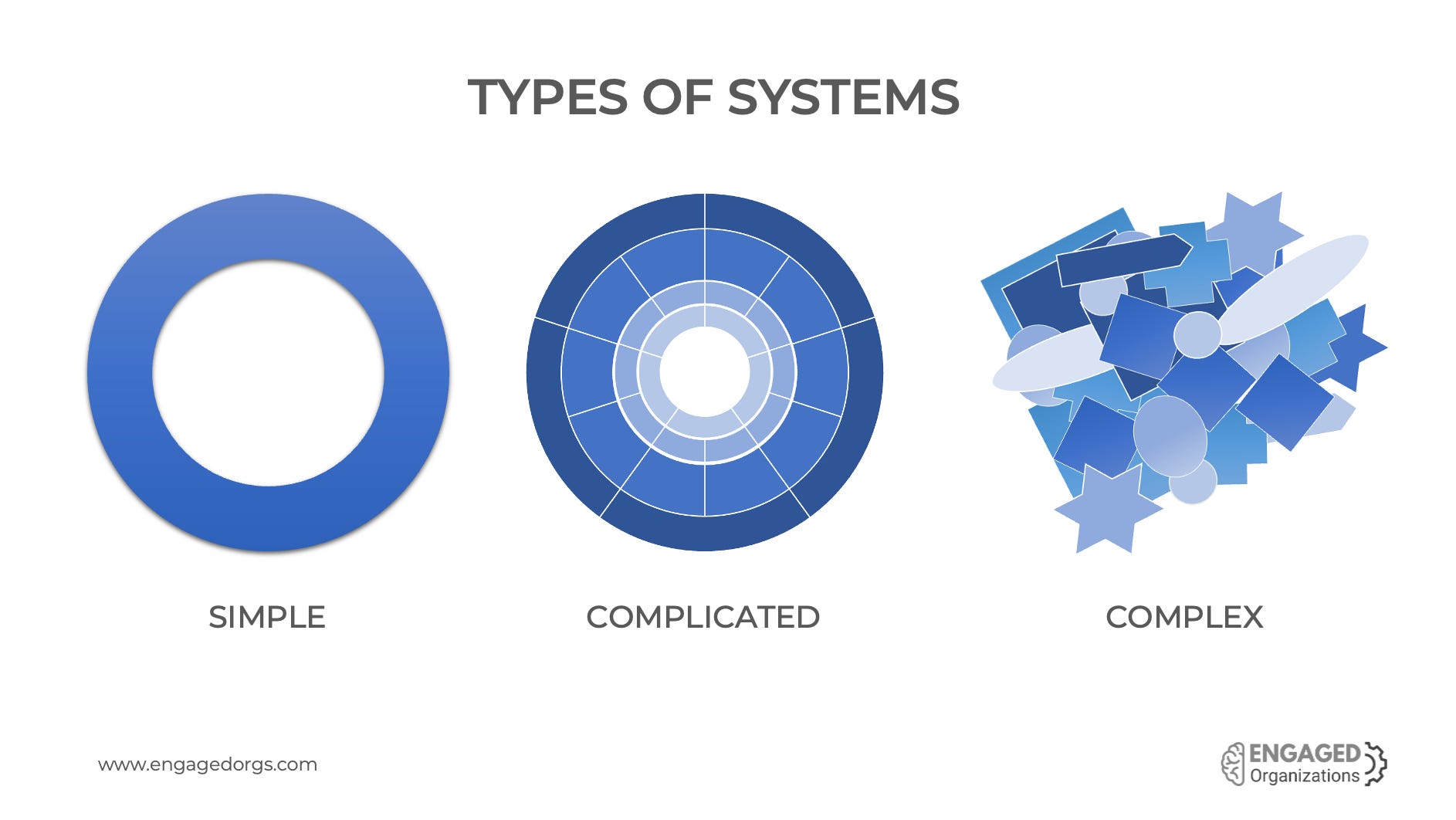
Complex systems rarely have a clear start or end point. They evolve rather than operate in the traditional sense. The components of complex systems behave differently in isolation than they do when combined. Their currency is diversity and interaction rather than reaching a goal post.
Many of the current problems I see in society are the result of framing the success of complex systems through a mindset developed to operate complicated systems…
…parents pressuring children to get straight As and do all the things to pad their emerging resumes in order to get into the ‘right’ school.
…schools rewarding children who conform and perform ‘perfectly’ rather than assessing their curiosity, interest, authenticity, or willingness to experiment.
…employers who want to hire individuals based on having done the exact same job for which they are hiring, rather than seeing skills as more than the sum of their parts and applicable across different contexts.
…the belief that AI is able to do knowledge work more efficiently because there is a gap in understanding that the value of knowledge is created by trust and relationships, not just the knowledge itself.
We keep measuring the success of human work by the standards we created to measure complicated industrial systems.
Assessing Success and Progress in Complex Systems
Most of us understand that the success of a child is not their grades or where they go to school, while also understanding that grades and attending certain schools can provide opportunities. However, we never reconcile the inherent conflict in a way that reduces our anxiety and eases how much of that anxiety we transfer to our children. A big part of this conflict stems from our assumptions about how to assess and communicate success - or the fear that even if we change how we assess success, others will not see it the same way.
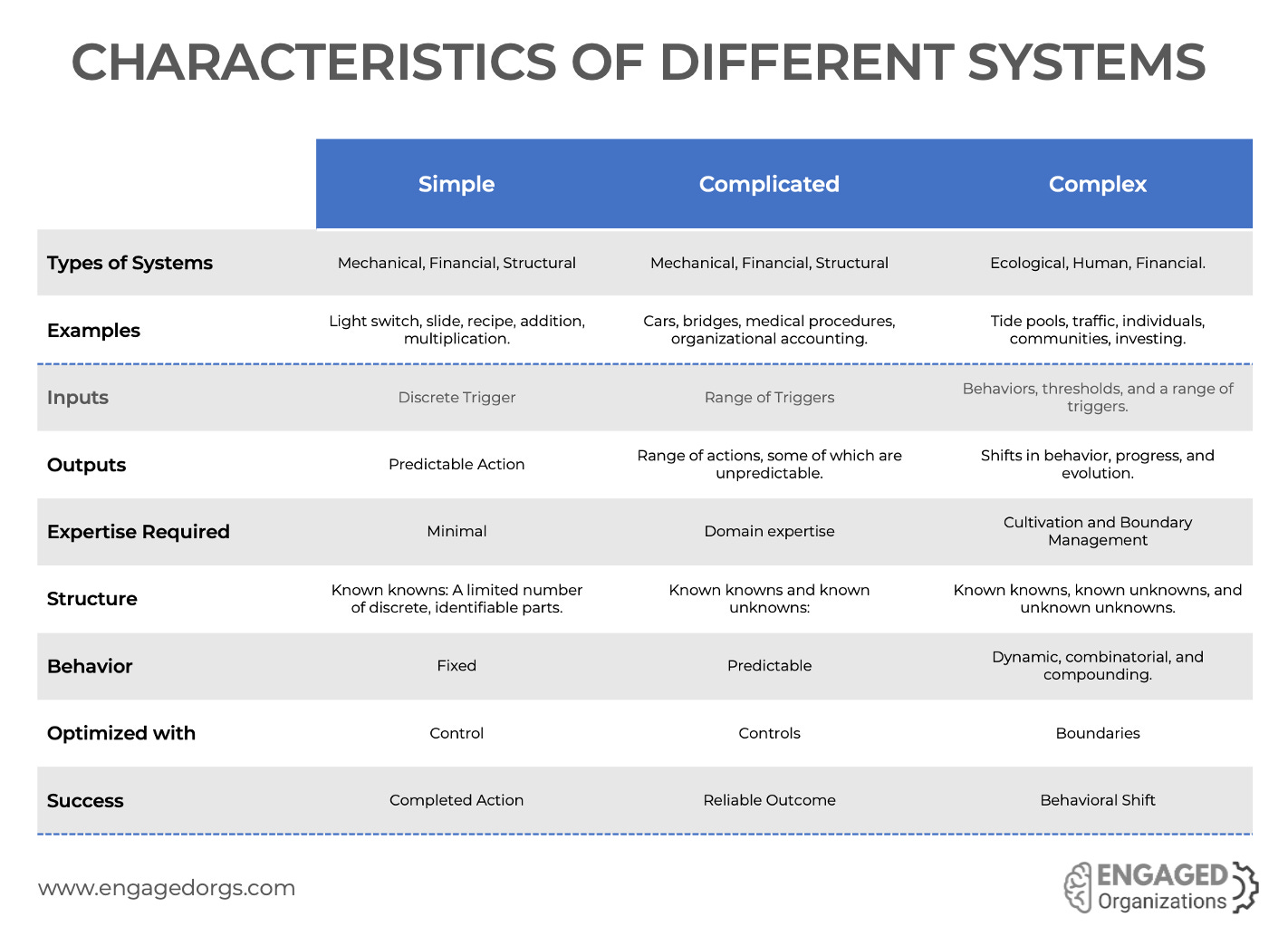
The conflict we are experiencing is the conflict created by applying the characteristics of complicated systems to complex systems. In complicated systems, which have easy to identify start and end points and predictable dynamics, fixed scores can be used to effectively assess and address gaps in performance. A complex child, who is evolving at a different rate and in a different way than any other child, and whose beginning is still hotly debated, cannot be effectively assessed by one, fixed grade. Children contain multitudes, and while we understand some things about the way in which they develop, much of it is still a mystery. They are unpredictable. Growth is not linear. Success is hard to pin down and means something different to each person.
We face the same conflict in the way we operate organizations. We treat jobs like a bucket of discrete skills, isolated from each other, relationships, and emotion. We treat success as demonstrations of knowledge when progress relies on influence, trust, and the ability to communicate, regardless of the specifics.
The soft skills are always critical to the effectiveness and value of information - but impossible to nail down into universal observable result. Leadership is the uniquely valuable skill of all individuals but we fail to recognize it. Instead, we are measuring humans the way we measure the reliability of a car. We face constant interpersonal conflict and tension as a result and cannot see that we are unnecessarily inflicting this on ourselves.
We use controls to ensure predictable human performance without understanding that controls do not optimize people the way they ensure reliability in machines. In fact, the more we try to control people, the more they resist and the worse their performance becomes.
Instead of being frustrated… we could just stop the madness. We could create a different approach to governing the people within our organizations - one that recognizes that the community of people within an organization behaves quite differently from the supply chain and accounting departments.
Defining What is Enough
Complex systems can not be optimized by controlling for defined outputs. Complex systems are generative and, at their best, produce a wild array of diversity. Diversity cannot be cultivated and optimized by defining it ahead of time; by definition we don’t know what it looks like before it emerges. By trying to control complex systems, we cut off the very excellence we want to inspire.
So, how are complex systems optimized? Through managing and negotiating boundary conditions.
Consider traffic - another complex system. It would be asinine to suggest that unless drivers take a specific route or travel to a specific destination, they have been unsuccessful. But we also don’t want behavior that causes harm or unnecessary congestion. We would prefer that vehicles stay on the road and stop for pedestrians. To shift the behavior of traffic, we create boundaries. Some boundaries encourage certain behaviors - like building highways and ensuring some roads are regularly paved. Other boundaries limit behaviors - like traffic lights and speed limits. As conditions change additional interventions are often necessary to maintain safety and access.
I participated recently in a traffic study, and I noticed most of the questions were oriented around my satisfaction level. They were assessing, essentially, what was good ‘enough,’ which is not a fixed measure but a measure of my expectations and experience.
We see progress in complex systems by watching shifts in behavior and engagement, not by a fixed destination or output.
Success is when we have done enough. What enough means is different for everyone and is critically defined differently by everyone. Each of us gets to define what enough is, which can be achieved by either changing expectations or by changing behaviors.
That may seem frustrating for those trying to design systems that work for a large organization. However, shifting to measure progress and behaviors vs. outputs is how to create universal measures that support a diverse community. Measuring behavior patterns also produces better intelligence about what boundaries might improve performance.
The challenge is not fixing the systems we have - but reframing how we think about and understand the system itself.
I think a lot about this line from Melissa Gregg’s book Counterproductive: “…we must now move the conversation about work from the angst of careers to the cultivation of atmospheres.” She meant it as an explanation of the book’s organization but it also hit me as a phrase relevant to my kids. They’re all new adults and super angsty. I tell them you can’t plan a path like I’ve had, you just cultivate atmospheres where the outcomes you want are more likely. Then I go on and on about the soil in my garden. If I haven’t lost them on the cultivating atmospheres phase, I definitely lose them at the soil science point.
Rachel again nice piece and we all live in the field of complexity (more on the gardening later) However our theoretical understanding of complexity is limited - its like using simple newtonian physics in a world where we know about quantum mechanics and multidimensions! That said there are a number of aspects that you point to here in looking at complexity and I would refer you to some of the work on leadership by Dave Snowden and Cynefin (welsh world for place/belonging) and also it anthropological aspects to it. I am on the journey to and about to write (a rare blog post) about exaptation and the City of Mainz! We may never understand and completely control complexity - but like waves in the sea we can learn to surf them!