

People Are the Weakest Link
Even if AI were perfect, people are at each end of the value chain

Fifteen years ago, in June of 2011, I keynoted at the Enterprise 2.0 conference in Boston, where I adapted the Red Queen Hypothesis to organizational systems. My main point was that technology was evolving far more quickly than humans ever could and, as a result, people were becoming the weakest link in organizational value chains. And this was long before AI hit the streets. You can see my slides here.
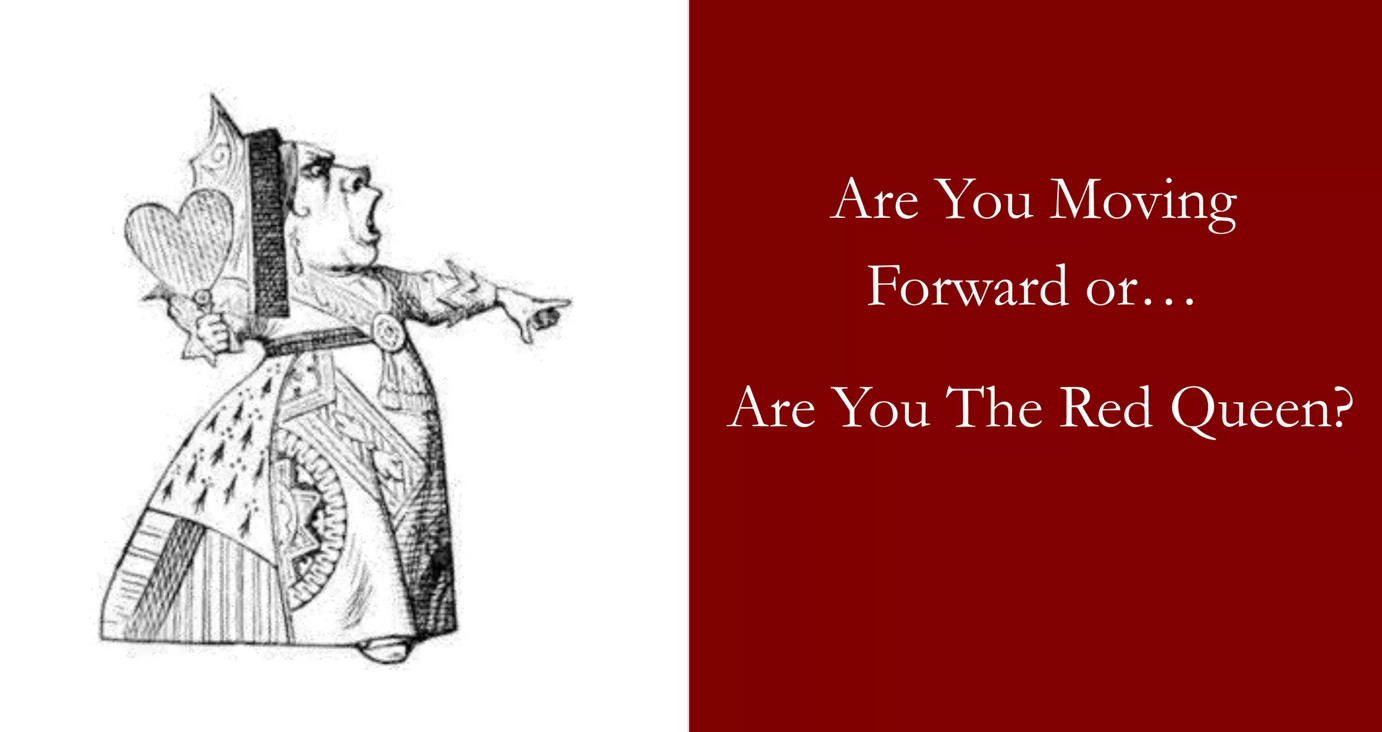
“Now, here, you see, it takes all the running you can do, to keep in the same place.” — Lewis Carroll
Humans will never be able to out-evolve technology, which means that we will fall further behind on everything technology can do - things like creating content, churning through numbers, identifying issues, fulfilling orders, and finding existing answers. The problem is that these activities have historically been the responsibility of employees (aka humans) and, as a result, it is how performance and progress is measured.
Now that technology, between AI and sophisticated robots, can do those more efficiently, we seem to be befuddled by the role of employees. However, it is people who still make buying decisions, people who use products and services, and people who decide what something means - and therefore determine its value. Markets are still people and the capacity of systems are limited by their weakest link.
Organizations With the Strongest Weakest Link Will Win
My hypothesis in 2011 was that organizations with the strongest relationships will win because those relationships differentiate products and services from commodities - and the resulting meaning, trust, attention, and empathy are what will maximize margins. In the last 15 years, my belief in that hypothesis has only gotten stronger because I still see organizations misunderstanding and treating human knowledge and skill as disposable and still thinking of employees’ value as fundamentally that of production.
Add to that, the marketing industry has created confusion between product characteristics like reliability and human relational traits like trust by suggesting people ‘trust’ products like laundry detergent. I don’t trust my laundry detergent, but I do value its consistency. I trust my friends, the people at my grocery store, and my auto mechanic. Trust, unlike expectations of consistency, is a bond that often strengthens with unpredictable exchanges and feedback - like the professor willing to spend time with you to explain why you got something wrong.
And still, organizations are laying off older workers in droves because they are expensive, in spite of the trust they have cultivated with colleagues, partners, and customers. Instead, organizations only see that their production can be replaced by AI. Organizations are also hiring fewer young workers because AI can do things faster, but unwittingly depleting their value chain of its long-term supply of trust and goodwill, which takes years to develop.
Humans Constrain the Value of AI
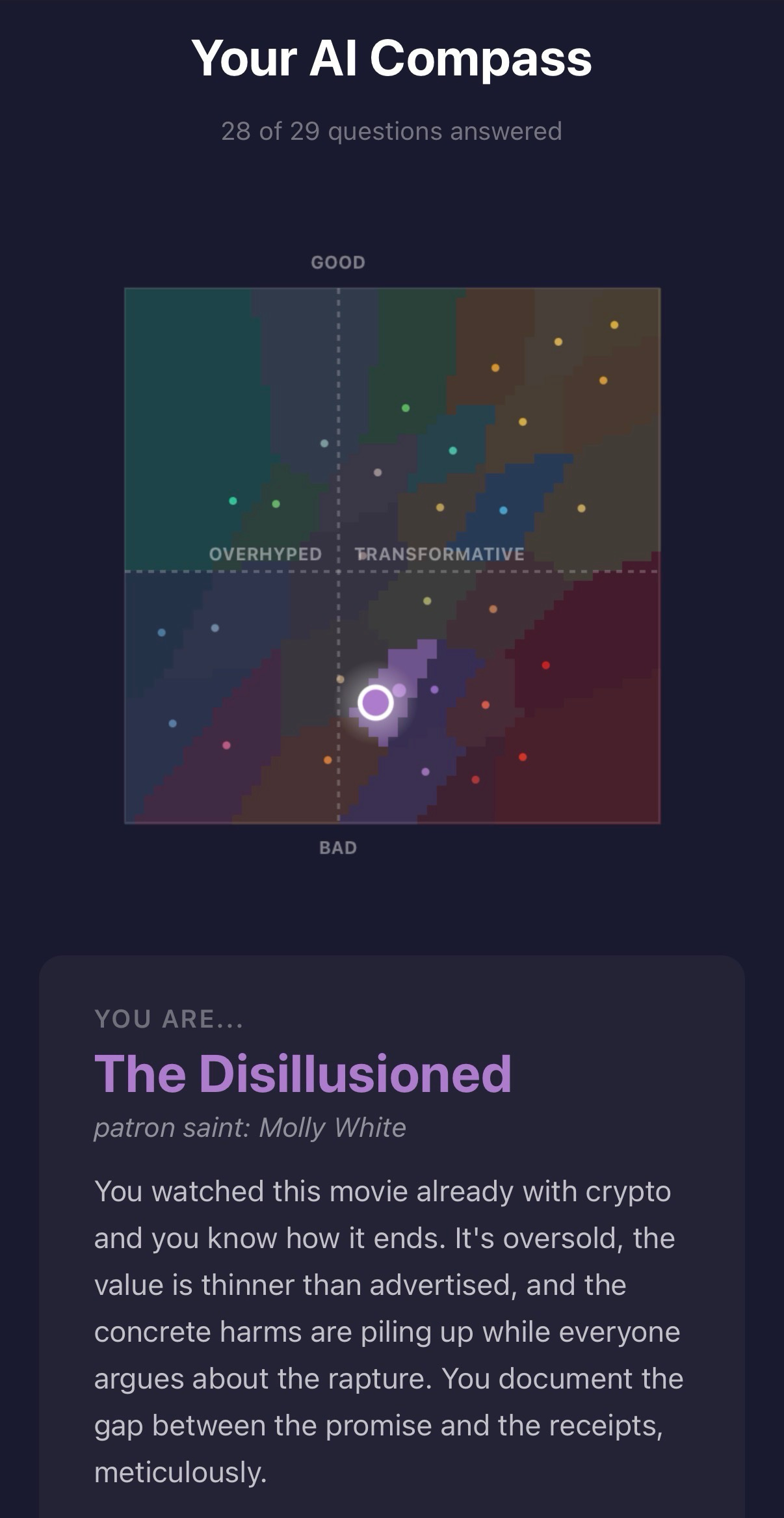
I suppose it is no wonder that on a silly AI personality quiz I was categorized with The Disillusioned. While I do believe AI has some real and valuable uses, it is currently chewing its way through online content people have published that should not, theoretically, be free to use and, once absorbed, will not grow at the rate needed for AI to meaningfully improve. As access to new content diminishes, AI will just abstract content it has already abstracted and, on the open Internet, become predictably mediocre.
Organizations with proprietary data will protect that data and sue those companies that use their terms of service to try and access it. Employees encouraged to use AI to create perfect emails, meeting minutes, and briefs will all start to sound the same and start to lose their influence over colleagues if they don’t differentiate themselves. Organizations will start to lose ground because the experienced (read: older) employees that they have laid off are not there to mentor newer employees, who don’t have the perspective and experience to ask AI the right questions, weakening their weakest link instead of investing in it.
We all will continue to lose resonance, meaning, and value and wonder what happened. Nothing happened other than that organizations tried to get their employees to behave like computers, and employees, customers, and partners lost any reason to connect, engage, and trust each other.
This may be why I have not been inspired to write much lately. Instead, I have been spending a lot of time in my garden, which may not be more meaningful to others, but I am struggling to find reasons to engage with a market obsessed with AI to the exclusion of things I think matter more.